Showing posts with label history. Show all posts

Tuesday, March 20, 2012

The Jewish mosque in the Jewish quarter

Visitors to the Old City of Jerusalem might ask themselves: What is a mosque doing in the synagogue complex in the center of the Jewish Quarter?

The Sidna Omar mosque is located right next to the Ramban and Hurva synagogues, two of the oldest synagogues in Jerusalem.

(Sidna Omar mosque next to the Hurva Synagogue)

The surprising answer, as it turns out, is that it was built by Jews. [The answer might be less surprising when we consider that most of our troubles are caused by in-fighting and Jews colluding with our enemies]

None other than the Bartneura (Rabbi Obadiah of Bertinoro), tells us the story of the mosque, in a letter he wrote shortly after arriving in Jerusalem in 1488 (Available online here, the translation is based on Brachae Slae's translation):
"In the synagogue courtyard, very close by, is a Moslem mosque. This site originally belonged to a Jew who converted to Islam as a result of a quarrel with his fellow Jews. When his mother saw that her sons had converted because of the vexation the Jews had caused him, she dedicated her home in the synagogue courtyard as a Moslem place of worship as an act of revenge upon the Jews. This is what has caused all the harm, destroyed the synagogue, and made the Jewish community suffer such a financial loss. Had the merciful Lrd not put it into the king's heart to take pity on the Jews, no Jews would remain in Jerusalem."
In this paragraph the Bartneura encapsulates the story of the Jewish community of Jerusalem in the 15th century. It was a difficult time for the Jews of Israel, but one also filled with great promise. The fall of Constantinople and the Byzantine empire, the wars by the Kingdom of Beta Israel against Christian Ethiopia, led many to believe that Redemption was near.

The story of the mosque and synagogue starts in the early 15th century. At the turn of the century the Jews of Jerusalem built a new synagogue, to be used for both the Ashkenazi and Sephardi communities. They of course had to pay off the Mamaluk rules to allow them to build it. The Ashkenazi community also bought a courtyard in that area.

Around the time the Ottomans conquered Constantinople (1453), the Jews of Jerusalem were forced to pay a great sum of money, convert to Islam or risk expulsion.

The story was written down by Rabbi Avraham Halevi Parnas, an emissary from Jerusalem to Europe [See Kovetz Al Yad 5, p45-50]. The letter he carried tells, in a manner very reminiscent of the Purim story, how the communities of Israel had to pay 100,000 gold florins to pay off the Mamaluk rulers. In Jerusalem they paid 10,000 gold florins, and the community had to sell off almost everything they had: hundreds of books and Torah scrolls, silver and gold Torah ornaments, as well as community-owned land. For the rest, they had to borrow at high interest.

The Bartenura, who was very critical of the way the community elders sold off all that was holy, explains that the Sultan, needing money for his wars, had demanded money from everybody in his kingdom, Jews, Christians and Muslims. The Jews of Egypt had also been forced to pay thousands of florins.

In any case, for years afterwards the Jerusalem community struggled to pay off remaining debts and additional taxes, which led to financial difficulties for all members. The wealthy and scholarly fled the city.

(Left: Sidna Ali mosque, Right: entrance to Ramban Synagogue)

In the early 1470s, a house inside the synagogue complex collapsed. The Muslims wanted to add its yard to the mosque. The case came to the Muslim courts, where the judges denied the request.

“But,” added the Muslim plaintiffs, “the synagogue is new, and should not even exist according to Muslim law.”

The courts continued to investigate, and the issue went all the way up to Sultan Kait Bey. The Jews had to admit that the courtyard had been bought 70-80 years earlier. One of the plaintiffs didn’t wait for a verdict. Inciting fellow Muslims to act, a mob destroyed the synagogue.

Kait Bey got upset and issued an edict that the synagogue should be rebuilt, and the attackers punished.

When the courts finally ruled on the matter, the Jews were forced to pay hefty fines, and, of course, the (re)-building expenses. Once again the Jews had to borrow at high interest, and the financial burden increased.

As if all that wasn’t enough, earthquakes, plagues and drought afflicted the residents of Israel throughout the century.
Link
When the Bartnerua came to Jerusalem in 1488, the community, a fraction of what it was earlier that century, still owed 1000 gold florins.

The Bartenura managed to renegotiate the tax burden, attract people to Jerusalem, re-open a yeshivah, and take the first steps to rejuvenate the community.

[This post is based mainly on "For the Sake Of Jerusalem" (Aharon Bier, translated by Brachae Slae), and "The history of Eretz Israel Under the Mamaluk and Ottoman Rule (1260-1804)" (Ben-Zvi Institute)]

See here for more articles about our history in Israel.

Visiting Israel?
Learn to Shoot at
Caliber-3 with top Israeli Anti-Terror Experts!


Follow the Muqata on Twitter.

Wherever I am, my blog turns towards Eretz Yisrael טובה הארץ מאד מאד

Wednesday, March 14, 2012

Ancient Palestinian coins

Shortly after the Palestinian Authority was established, I was browsing the PA website when I discovered a section entitled "Ancient Palestinian Coins". Intrigued, I checked it out. What coins could they possibly claim to be Palestinian?

As it turns out, the coins not only weren't "Palestinian" as such, they weren't "Ancient" either. In fact, some of them weren't 'Coins', but rather 'banknotes'. Because the only money in known history to say "Palestine" was produced by the British Mandate, back when both Jews and Arabs were considered "Palestinians".

In Hebrew the coins said "Palestine (Land of Israel)".

Palestinian Media Watch reports that the Palestinians are still looking for those ancient Palestinian coins.
A Judean Shekel coin from the year 66 CE, the first year of the Jewish rebellion against Rome, was sold for $1.1 million this past week at an auction in New York. The words in Hebrew "Shekel of Israel [Year] 1" are printed on the front of the coin, and "Jerusalem the holy" appears on the back. [New York Post, March 10, 2012]

The official Palestinian Authority daily in writing about the auction described the Hebrew coin from the Second Temple period as an "ancient Palestinian coin" and as being part of the "Palestinian cultural tradition."

left: "Shekel of Israel", golden cup from the vessels of the Temple
right: "Jerusalem, the Holy", branch with three pomegranates

I'm sure that when the PA gets around to minting their own coins, they'll use these examples of ancient Palestinian tradition as their prototypes. Because nothing says "Palestinian" like Jews fighting for their homeland, rejecting Latin and Greek influence, and making their own Hebrew coins depicting images from the Jewish Temple.

Who knows, maybe the next step will be to adopt Hatikva as the Palestinian national anthem. After all, what other song really embodies the Palestinian age-old quest for freedom in their own homeland?

For more on the collection of "Ancient Palestinian Coins":


See here for more articles about our history in Israel.

Visiting Israel?
Learn to Shoot at
Caliber-3 with top Israeli Anti-Terror Experts!


Follow the Muqata on Twitter.

Wherever I am, my blog turns towards Eretz Yisrael טובה הארץ מאד מאד

Tuesday, March 13, 2012

The Case of the Drunk Muslim

Not many history books were written in this land in the past 2000 years. Our history in this period is pieced together from Halachik writings, accounts of pilgrims and travelers, personal letters and government reports.

The two stories I bring below are very similar, though they come from different sources and different time periods, and they give us insight into the day-to-day difficulties of living here in previous centuries. Because sometimes, you could find yourself being charged for murder, just for selling wine.

The first story is from the Mamaluk period. In a letter written to his father in 1488, the Bartneura (Rabbi Obadiah of Bertinoro) had one good thing to say about Israel. People here are G-d fearing. Even the "evil and sinful" leaders of the Jewish community in Jerusalem, of whom he was very critical, would hurry to prayer and to do other commandments between man and G-d.

Here you won't find a Muslim who curses G-d, like the Christians in Europe do. The Bartneura points out this is the only thing that keeps this land from complete anarchy, since the Muslims have no order and no justice, and the courts do whatever they please. To illustrate his point he brings the following story:

A Muslim got so angry with his mother that he "slaughtered her like a sheep". When he was brought to court, he claimed he had been drunk.

Who makes wine? Only the Jews and Christians do, so obviously they were to blame. The Jews were fined 6 gold florines, the Christians 12 gold florines, and the Muslim got off scot-free.

If they had such laws in Europe, says the Bartenura, they would eat each other alive.

Renewing the tradition. Vineyards in the Shomron mountains.
The second story is from the Ottoman period, and shows that things didn't change much in the previous 250 years. This story appears in a responsa by Rabbi Nissim Chaim Moshe Mizrachi, the Chief Rabbi of Jerusalem in 1745-1749 (Admat Kodesh 1 Choshen Mishpat 72). The story is a bit convoluted, so bear with me.

Two Muslims fought in the market and one killed the other. The killer's family said in his defense that he had been drunk and had no idea what he was doing. The judge started investigating whether he had been drunk, and who sold him the wine.

Feyge was an Ashkenazi Jew living in Jerusalem. That in itself wasn't such a simple thing in those days. Twenty five years earlier all Ashkenazi Jews were run out of town after the community was unable to pay its debts. The Ashekenazi Jews left in Jerusalem all lived "undercover", pretending to be Sephardi Jews.

As it happened, Feyge, like other Jewish women in town, made a living by selling wine. And as it happened, one of the court officers had showed up at her house for several days with a big bottle, telling her he had been sent by the head of the Jewish community, and demanding she give him free rose-water. When she refused he threatened he'll get his revenge.

Finding this a good opportunity, the court officer went to Feyge's house and demanded money or he will finger her as the woman who sold wine to the murderer. Feyge had no choice and paid him off.

However, somebody reported Feyge anyway, and the city governor sent his people to get her. They didn't find her because Feyge went into hiding. The governor then turned to the head of the Jewish community and told him to find the woman, since he wants to hang her. As was usual at the time, this was just an invitation for negotiations, and the two settled on a sum of bribe money for Feyge's life. The Jewish leader, who did not himself have such a huge sum, then went looking for Feyge to get the money, but he couldn't find her either.

Wine barrels at the Shiloh Winery. 250 years later,
some people still equate Jewish wine making with murder

"Don't worry," said the governor's men. "We know other women who sell wine, we'll get the money for you."

The 'bribe-collectors' showed up at the women's houses and demanded they give them money, otherwise they'll inform on the authorities that woman sold the wine which led to the murder.

The money was collected, Feyge's life was spared, and everybody was happy.

Except for the fact that fifty four women sued Feyge to get their money back. Poor Feyge's defense was as follows: You know that murderer never entered my house. I lost money due to bad luck, and you lost money due to bad luck. It happens. The Chief Rabbi agreed with her and ruled in her favor.

Life was difficult, but the Jews in these stories don't come out smelling all rosy either. The Bartneura was impressed that people here were G-d fearing, but as he himself points out, fearing G-d doesn't make one a mensch.

See here for more articles about our history in Israel.

Visiting Israel?
Learn to Shoot at
Caliber-3 with top Israeli Anti-Terror Experts!


Follow the Muqata on Twitter.

Wherever I am, my blog turns towards Eretz Yisrael טובה הארץ מאד מאד

Tuesday, March 06, 2012

A Tiberias Purim: The story of a Sheik, a Pasha and a Rabbi

Some Jewish communities celebrate their own special Purim days, marking the day when the community was saved from those who wished them harm. Tiberias has two such Purim days, celebrating an event that took place in the early 18th century.

The cast of this particular Purim story:

In the role of King Ahasuerus - Sheik Daher el-Omar, one of the most benevolent rulers under the Ottomans. El-Omar was a Bedouin whose family came to Israel in the late 17th or early 18th century. He conquered the Galilee in the years 1720-1730, getting official Ottoman recognition of his rule ex post facto. Realizing that safe roads, thriving commerce and enterprising people were a sure-fire recipe for increased tax revenue, he invited various groups, including Jews, to come to the Galilee. During his 50 year reign he managed to conquer all of Israel, save for Jerusalem, making him the only Arab to rule the land in the past millennium.

In the role of Mordechai, Rabbi Hayyim Abulafia. Born in Hebron, his family later moved to Jerusalem. In the early 1700s he served as Chief Rabbi of Safed and would often visit the ruins of Tiberias, to pray by the holy graves. He served as Rabbi of Izmir in Turkey for close to 20 years before coming back to reestablish the Jewish community of Tiberias.

In the role of Haman - the evil Governor of Damascus, Sulayman Pasha al-Azm.

And, last but not least, in the role of the Narrator, Rabbi Yaakov Berav, son-in-law of Rabbi Abulafia and a descendent of the more famous Rabbi Yaakov Berav (the First). Rabbi Berav recorded the events in his book Zimrat Ha-aretz (available online at HebrewBooks). An English summary of Rabbi Berav's account appears in "The Goodly Heritage" by Abraham Yaari.

Sadly, there was no Esther in this story. But the good news is that we didn't need intermarriage to save us either.
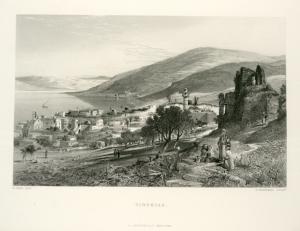
Tiberias. Digital ID: 80442. New York Public Library
Tiberias, Fenn & Brandard, 1881


Our story begins way, way back, close to 270 years ago. The year was 1738, and Daher el-Omar was a rising star. Hearing that Rabbi Abulafia, who was already in his eighties, wanted to come home, he wrote the Rabbi and asked him to "Come and inherit Tiberias, the land of your fathers". The Sheik wasn't speaking figuratively, for Rabbi Abulafia's grandfather, Rabbi Yaakov Abulafia, was the Chief Rabbi of Tiberias before its destruction.

When Rabbi Abulafia arrived in Tiberias, in 1740, the Sheik dressed him like royalty, and offered him whatever his heart desires. The Rabbi took him up on his offer, and Daher el-Omar built the Jews houses and courtyards and the most beautiful synagogue in all the land, and that's besides the bathhouse and shops and roads and the fields he had planted.

El-Omar fought the (other) Bedouins and made it possible to travel safely on the roads. Alone! with Money! The Land was as peaceful as in the days of Solomon. And yet, far away, trouble was brewing. In Istanbul, the Ottoman Sultan was getting reports of el-Omar's conquests and independence, and ordered the Governor of Damascus, Sulayman Pasha, to take care of the young upstart.

On August 11, 1742 (22 Av), Rabbi Abulafia received warning from the Jews in Damascus that Sulayman Pasha was going to attack and destroy Tiberias. The Rabbi warned the Sheikh, but el-Omar was sure the Pasha was just huffing and puffing and wanted to be paid off. After all, if the Sultan was involved then surely the Jews of Istanbul would have warned the Rabbi. Besides, el-Omar was under the jurisdiction of the Governor of Sidon, and he paid his dues to the Sultan. There was nothing to worry about.

The Jews of Damascus, worried about their brethren in Tiberias, continued to update the Rabbi, but despite repeated warnings, the Sheikh was sure nothing was going to happen, and did not prepare for war.

Enter Sulayman Pasha, stage right, setting up camp outside town.

The Jews were terrified and wanted to leave to Safed or Akko, where they had been promised safety by the Governor.

Rabbi Abulafia refused to hear of it. He would not leave the Holy City and the beautiful synagogue after all the trouble he had put into it. He did not want his community to become moneyless refugees. If the Jews left, it would shame the Sheik, and it will cause hatred and enmity for generations to come. If we leave, he reasoned, everybody will say 'what's the point of bringing the Jews here? Not only are they not fighters, they flee and spread fear'. The roads are dangerous now and the journey difficult, and the aged Rabbi was too old for the trip. G-d has given us the strength to rebuild Tiberias, he said. He did not do so in order to destroy us.

The next day the Jews went to the graves of Rabbi Hiyya and his sons, and of Rav Huna, and of Rav Hamnuna the Elder, and prayed and wept and sounded the shofar.

On Shabbat, August 28 (9 Elul), Sulyman Pasha started the attack. Immediately killing 14 of his own people with a wayward cannonball. There was much rejoicing in Tiberias. But the Governor was not deterred, that evening he started shelling the city with different types of cannons. Rabbi Berav notes that forty of the bigger cannonballs conquered a big city. The Pasha fired more than 200 such cannonballs at Tiberias, and the city withstood the attack. The Pasha also fired 1500 smaller cannonballs at the city.

Most fell into the Kinneret (Sea of Galilee). The rest exploded in mid-air, bounced harmlessly off the roofs or whizzed between the people walking in the streets. No house was destroyed, not one man was killed, even the animals and birds were spared. Though the people had a lot of flammable materials on the rooftops, the attacks didn't start a fire. A few of the cannonballs fell in the Rabbi's courtyard and were later kept in the Rabbi's house as evidence of the mercies of G-d.

While the shelling was going on, the Jews kept going to the synagogue, and on Shabbat, Rabbi Abulafia encouraged them: the Pasha is not fighting the people of Tiberias, he said. He's fighting G-d. G-d will save us, and will save the rest of the people of Tiberias as well.
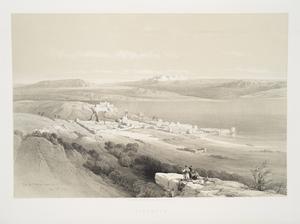
Tiberias, looking towards Herm... Digital ID: 83004. New York Public Library
Tiberias, David Roberts, 1842-1849


The High Holidays came and went, and then Sukkot, and the Jews celebrated Simchat Beit HaShoeivah every night with joy and song, but one thing was missing: except for the Lulav, they had none of the Arba Minim. Every day they hoped, "G-d will make us a miracle tomorrow", but the days passed, and the last day, Hoshana Raba was upon them, and no Arba Minim.

Throughout all this, Sheik el-Omar kept sending the Pasha gifts and trying to make peace. And miracle of miracles, one of those peace parties was sent out on Hoshana Raba. One of the Jews from the Governor's camp used the opportunity and brought in the missing Arba Minim. The Jews were so ecstatic about being able to fulfill the commandant, they cried tears of joy as they made the blessings.

The Governor continued plotting and trying various tricks to breach or break down the city walls. Every time the people thought this was their end, but the miracles continued. Every attempt was repulsed by Daher el-Omar and his people, to the surprise of the Pasha, who really didn't expect a Bedouin to be this smart.

The Governor thought he could dig trenches down to the foundations of the walls and blow them up, but after five days of hard work, they discovered they weren't digging straight. It has to be Jew voodoo, said the Pasha's engineer, the Jews' Rabbi must have cast a spell on us. What shall we do?, asked the Pasha. Simple, fight Jew voodoo with Jews. And indeed, ten Jews were brought in from Safed - secretly, so that the Rabbi would not cast a spell on them too - and forced to dig the trenches. Surprisingly, this did not make the trenches any straighter.

And on Shabbat, November 20 (4 Kislev), after 83 days of siege, the Pasha was finally forced to give up, since he had to escort the pilgrims to Mecca. The siege was lifted. It was only then that the Jews of Tiberias learned that for the past three months, while they were under siege, Safed had been hit by the plague. The siege had been a blessing! Looking back at the chain of events, they realized that everything had been stacked against them, making their victory that much more miraculous, that surely it had all been G-d's work. Sorrow turned to gladness, and mourning into a good day (Esther 9, 22).

Rabbi Abulafia said Ha'Gomel in the plural for everybody, and they said the Hallel, and with the Rabbi's blessing they decided to make the 4th of Kislev a day of joy and celebration, a Purim, for generations to come.

Once the Governor of Damascus returned home, he was greeted with ridicule by his people. He had all the might and technology of the Ottoman empire on his side and still he couldn't beat one poorly-prepared Bedouin. And so Sulyman Pasha resolved to attack Tiberias again, and this time he will not return before he has destroyed the city, even if it will take all his money to do so.

Meanwhile, the Sheik asked various messengers to speak with the Sultan on his behalf, but the Jews of Istanbul sent a message through Damascus, explaining that nobody dared speak up. The Sultan had made up his mind and was arming Sulyman Pasha.

When the people heard this, they were terrified. Rabbi Abulafia told them: Whoever wants to, can leave, and whoever doesn't, can stay with us, do not fear for G-d is with us. Most of the people of Tiberias fled, but some remained to honor their Rabbi. Rabbi Abulafia was so certain they had nothing to fear, that he did not even prepare supplies for the coming siege.

The Pasha was much more prepared this time. He gathered an even bigger army and more weapons, and set out again for battle. Shabbat Eve, August 12, 1743 (3 Elul), he reached the village of Lubya (Kibbutz Lavi), two hours walk from Tiberias. The people of Tiberias were already mourning the calamity that will soon befall them.

On Shabbat Eve the Rabbi's son would read the Haftara portion by the table, and that week the Haftara was from Isaiah: "I, even I, am He that comforteth you: who art thou, that thou art afraid of man that shall die" (Isaiah 51, 12), and the Rabbi told his family: Do not fear, listen to what G-d is telling us. The next day in the synagogue his sermon centered around the verse from the weekly Torah portion of Shoftim "For the LORD your God is He that goeth with you, to fight for you against your enemies, to save you" (Deuteronomy 20, 4). Do not fear a man who shall die, the Rabbi promised the people, for the Pasha will not get to Tiberias, and will not put up siege against us.

On Sunday a messenger came to town and said that the Pasha had been stricken with a serious illness. At first the people thought this was a trick, but that Wednesday more messengers came and reported that the Pasha had died the previous day, that all the weapons had already been taken to Akko, and that the Pasha's body was on its way to Damascus.

Once again, there was much rejoicing. That Shabbat the Rabbi spoke of the great miracle that had happened to them, that was even bigger than the first, and the people accepted upon themselves to celebrate the 7th of Elul, the day the Pasha died, for generations to come.

Rabbi Yaakov Berav ends his story: "So may all your enemies perish, L-rd. May you show us the great Redemption with the coming of our Messiah speedily in our days. Amen, may it be the will of G-d."

See here for more articles about our history in Israel.

Visiting Israel?
Learn to Shoot at
Caliber-3 with top Israeli Anti-Terror Experts!


Follow the Muqata on Twitter.

Wherever I am, my blog turns towards Eretz Yisrael טובה הארץ מאד מאד

Tuesday, February 28, 2012

The Pioneers of the Citrus Industry

Sometimes, one decision can make the difference between making history and becoming a footnote.

Dov David Fellman, a businessman from Mezritsh (Mezhirichi ), came to Israel in 1883, on a pre-Aliyah trip. He toured the land, visited the existing Jewish villages of the time, and decided to start off his own farm, and so set an example for others.

Becoming an Ottoman citizen so he could buy his own land, he bought 10 acres in the Arab village of Sumeil. Sumeil, more than an hour's donkey ride from the Jews of Yaffo, was located in what is today the 'old North' of Tel Aviv, between the streets of Ibn Gabirol, Alrozorov and Shlmo Hamelech.

In the winter of 1884 he brought his family to Israel - his mother, his wife Sarah Itta (his second marriage), and his seven children (ages 17 to 1). They were accompanied by R' Baruch Meir Rozenblum, teacher and butcher, and by the family's maid.

Sarah Itta and five of her children (1884)


David Fellman wanted to be prepared, and so he bought a few books before boarding the boat, and on the way over taught his family Arabic and read up on farming and agriculture.

On their new homestead the family planted an orange grove and on the rest of the land they planted wheat, barley and vegetables, and had cows and chickens. David would start off every day with his morning prayers and learning Mishnah, he would then go to Yaffo to sell his produce, come back, work in the fields with his two eldest sons, and end the day with the evening prayers and a page of Gemarah.

The Fellmans faced many hardships that winter, but the hardest for David was that, due to the Shabbat travel limits, he could not pray in a minyan (quorum) on Shabbat. Together with R' Meir he studied the Halacha and possible solutions. They went out to measure the 'techum shabbat' distances, but Yaffo was simply too far away. The first 'techum shabbat' ended on what is today Hamelech George street in Tel Aviv. The second ended where the neighborhood of Neve Shalom was later built.

But he was willing to put up with everything for his belief that this was his contribution to Redemption, and that once he blazed the trail, others will follow.

That summer, disaster struck. David Fellman died from misdiagnosed heatstroke. A few weeks later, the baby daughter died of malaria.

Well wishing rabbis tried to convince the new widow, just 27 years old, to go back home to Mezritsh. Rabbi Diskin of Jerusalem told her: "I've never told a Jew to leave Israel, but my advice to you is to leave. You're a widow with six orphans!" But Sarah Itta was determined to stay on the farm, her husband's dream and legacy. This was the land for which he died, and this was where she was going to stay.

Sumeil (1946), viewed from Tel Aviv


Tel Aviv (1946), viewed from Sumeil


Life was very difficult, but nothing deterred Sarah Itta. The farm was in debt, so she sold off her jewelry and got a loan from Rothschild. With time and effort the orange grove became a profitable business. Sarah Itta even surprised Rothschild by returning the loan.

When Baruch Meir Rozenblum, the children's teacher, left for other endeavors, she brought in other Torah scholars: Rabbi Shaul Shaulzon from Hebron and Rabbis Dov Marcus and Nachman Gedalia Broder from Jerusalem. The latter, who came with his wife, later became known as an authority on the Etrog.

The Fellmans became the national experts on orange growing. In 1989, when R' Aryeh Lev Frumkin planted the first orange grove in Petah Tikva, he bought the saplings from the Fellman farm. The Fellman sons helped out in the orange groves of Petah Tikva, Hadera and other Jewish villages. In 1891 the eldest son, Aharon Lev Fellman, wrote "Ma'ayan Ganim", the first (Hebrew) book on orange growing (available online as PDF).

The Arabs of Sumeil had a lot of respect for their new neighbors. When they first arrived, the village sheik, Muhammad Abu Jabra, would help David Fellman out and, at first using sign language, taught him how to work the land. When Bedouins stole something from the orange grove, Abu Jabra fined the robbers and the Fellmans donated the money to the village poor. Another time Bedouins robbed the house when the boys weren't home. The Arab neighbors heard shots and came to protect their neighbors, fighting throughout the night until they managed to fight the robbers off.

Another time an Arab child drowned in the farm's water hole. Arabs gathered from near and far, and a lynch mob started forming, accusing the Jewish family of killing the boy. But the child's mother stood between them and Sarah Itta "My son was as dear to her as he was to me. Woe to whomever touches her."

The older sons got married in Sumeil but once the grandchildren were school-age, they moved to the new Yaffo neighborhood of Neve Zedek. At the turn of the century, after fifteen years on the farm, Sarah Itta bowed to family pressure and moved to Yaffo. There she got involved with community and charity affairs, but she didn't leave her beloved farm - every day she would ride to Sumeil, supervise the workers and meet with her former neighbors.

In 1917, towards the end of World War I, the Turks forcibly evacuated Yaffo and the new city of Tel Aviv. Though the deportation order applied to everybody, the Turks turned a blind eye to the fact that most Arabs set up camp in the nearby orange groves.

The Fellmans hid their belongings in Sumeil, by Sheikh Abu Jabra. For a while they were in Kalkilyah (Qalqilya), where Sarah Itta set up a bakery for the benefit of the Jewish evacuees. They then moved north and settled in Tiberias, where one of the sons ran the concession stand in the Zemach (Samakh) train station.

In the 1930s, as the city of Tel Aviv grew, the agricultural land of Sumeil became valuable real estate. The Fellmans, like their Arab neighbors, were offered a lot by builders. In 1936, shortly after the family sold the farm, Sarah Itta passed away.

In 1934, the city of Tel Aviv celebrated the 50th anniversary of the establishment of the Fellman farm. Hundreds of dignitaries came from across the country and Mayor Meir Dizengoff and the city council crowned Sarah Itta "the pioneer of Hebrew citrus farming".


Anybody who visits Tel Aviv can visit the Fellman farm - today hidden under Rabin Square, the Tel Aviv municipality, Gan Ha'ir and dozens of apartment buildings - and honor the first Jews who lived here, who put Torah above everything, and who were convinced that Redemption will only come by buying land, planting an orchard and sticking it through.

[The pictures in this article were posted online by Sarah-Itta's great-great-grandchild.]

See here for more articles about our history in Israel.

Visiting Israel?
Learn to Shoot at
Caliber-3 with top Israeli Anti-Terror Experts!


Follow the Muqata on Twitter.

Wherever I am, my blog turns towards Eretz Yisrael טובה הארץ מאד מאד

Sunday, February 19, 2012

The Shabbat Jerusalem got snowed in

Due to the Jerusalem snow storm that wasn't, here's a story of a snow storm that was.

In 1787, on the week of Parshat Beshalach, a major snow storm hit Jerusalem. Starting on the Wednesday of that week (Jan. 31 - 12th of Shevat), and for three whole days, it snowed and snowed. The snow piled up in the streets man-high, covering up the doors and preventing people from going out. The gates of the city, usually open during the day, remained shut.

Rabbi Moshe Yosef Mordechai Meyuchas, the Chief Rabbi of Jerusalem at the beginning of the 19th century, describes it as "something like we've never seen, and never been told by our fathers".


The snow was so heavy that the roof of the Istanbuli Synagogue collapsed. The Ottoman authorities did not allow the Jews to rebuild the roof, and it was only in 1835, under the rule of Muhammad Ali Pasha, that the synagogue was repaired.

Come Shabbat (Tu Bishvat) the Jews were faced with a problem. The synagogues were low, impossible to access, and remained closed. Will they have to go a Shabbat without reading the Torah?

Luckily, there was one building which was high and accessible: the Kabbalist Bet El Synagogue (Yeshivat haMekubalim). Rabbi Yom Tov Elgazi, the Chief Rabbi of Jerusalem and head of the Bet El Yeshiva, managed to get together 2-3 minyans and read the Torah.

Rabbi Meyuchas says that he himself lived far from the 'street of the Jews'. He had a Torah scroll at home, but could only get together eight men, not enough for a minyan. They had to pray the morning Shabbat prayers without reading the Torah. They then sat down together for the Shabbat morning meal.

However, later in the day, sometime around noon, Rabbi Meyuchas got a heaven-sent gift: two golden Torah ornaments. He used the ornaments to complete the minyan, and the group read the Torah.

[This post is based on the story as told by Rabbi Moshe Yosef Mordechai Meyuchas in his book "Brachot Mayim". For those interested in the Halachik aspects, Rabbi Meyuchas discusses his reasoning in the book. The story of the snow storm was copied in easier-to-read Hebrew by Rabbi Avner Afgin in his book "Divrei Shalom".]

See here for more articles about our history in Israel.


Visiting Israel?
Learn to Shoot at
Calibehttp://www.blogger.com/img/blank.gifr-3 with top Israeli Anti-Terror Experts!


Follow the Muqata on Twitter.

Wherever I am, my blog turns towards Eretz Yisrael טובה הארץ מאד מאד

Sunday, February 12, 2012

Israeli Bingo

On Tu Bishvat we were visited by a youth group who came to plant trees. One of the groups had been playing Israeli Bingo on the way, with each card listing important people from Israeli history.

Not surprisingly, 99% of the names on the bingo cards were either pre-Exile or Zionist-era people.


Therefore, I thought I'd use the opportunity to list some of the more well-known Israeli writers, scholars and leaders throughout the ages. Maybe next time I'll find their names on school-children's bingo cards.

  • Rabbi Yochanan (3rd century) - laid the foundations of the Jerusalem Talmud
  • Shimon ben Lakish (Resh Lakish) (3rd century, ) - leading Talmud scholar
  • Rabbi Tanhuma bar Abba (4th century) - leading Aggadah scholar
  • Our early poets (4th-10th centuries) - Jose b. Jose, Yanai, Eleazar Kalir. Wrote many of the religious hymns in Ashkenazi prayer books.
  • Aaron ben Asher (10th century) - Bible Masorah authority. Added the masorah notes to the Aleppo Codex, the basis for all our Bibles today.
  • Judah Halevi (12th century) - poet and philosopher, author of the Kuzari, believed that true religious fulfillment is only possible in Israel.
  • Benjamin of Tudela and Yehuda Alharizi (12th century) - travelers who visited the land and described its Jewish communities
  • Samson ben Abraham (Rash of Sens, 12th century) - one of the leading French Tosafists, led the first wave of the Tosafist Aliyah in the early 13th century.
  • Nahmanides (Ramban) (13th century) - reestablished the Jewish community in Jerusalem, following Crusader rule
  • Rabbi Ishtori Haparchi (14th century) - studied the geography and plant life of the land, lived in Beit Shean
  • Rabbi Obadiah of Bertinoro (15th century) - author of the popular commentary on the mishna, helped rejuvenate the community of Jerusalem
  • Dona Gracia Mendes Nasi (16th century) - the 'first Zionist', leased the area of Tiberias to create an autonomous Jewish region.
  • Rabbi Isaac Luria Ashkenazi (The ARI) (16th century) - founder of the Kabbalist movement of Safed
  • Rabbi Jacob Berab (16th century) - reintroduced Semichah (rabbinic ordination)
  • Rabbi Joseph Karo (16th century) - author of the Shulchan Aruch
  • Rabbi Israel ben Moses Najara (16th century) - poet, kabbalist and chief Rabbi of Gaza
  • Rabbi Isaiah Horowitz (Shelah ha-Kadosh) (17th century) - Mussar (ethics) scholar who greatly influenced the Hassidic movement.
  • Rabbi Judah HeHasid (17th century) - led mass aliyah movement to Israel, built the Hurva synagogue
  • Sar Shalom Sharabi (Rashash, 18th century) - head of the Kabbalist Bet El Yeshiva in Jerusalem
  • Haim Farhi (18th century) - adviser to Ottoman rulers in the Galilee
  • Rabbi Hayyim Abulafia (18th century) - restored the Jewish community of Tiberias
  • Rabbi Moshe Chaim Luzzatto (RAMCHAL, 18th century) - author of the "Messilat Yesharim" which became the basis for the Mussar Movement
  • Yisroel ben Shmuel Ashkenazi of Shklov (19th century) - student of the Vilna Gaon, Wrote the "Pe'at Hashulchan" on the laws of the land, helped rebuild the Hurva synagogue.
  • Rabbi Shlomo Zalman Zoref (19th century) - founder of the Solomon clan, renewed the Ashkenazi Jewish community in Jerusalem
  • Israel Beck (19th century) - First Israeli printer in the modern era, established the first Jewish agricultural village (on Har Meiron).
  • Rabbi Akiva Yosef Schlesinger (19th century) - Aliyah activist, believed Jews can only be redeemed by turning to productive work and agriculture
  • Rabbi Yechiel Michal Pines (19th century) - one of the fathers of religious Zionism.
See here for more articles about our history in Israel.

Visiting Israel?
Learn to Shoot at
Caliber-3 with top Israeli Anti-Terror Experts!


Follow the Muqata on Twitter.

Wherever I am, my blog turns towards Eretz Yisrael טובה הארץ מאד מאד

Sunday, February 05, 2012

Tu Bishvat: A holiday rooted in Israeli tradition

Tu Bishvat (the 15th of Shvat), the holiday celebrating the fruit of Israel, has ancient Israeli roots, though we wouldn’t know about them if not for the Cairo Genizah.

The date itself is first mentioned in the Mishnah, as the “New Year of the Trees”. This “new year” was not a holiday; rather just a date for determining when the year starts for the purpose of tithing the fruits.

A mosaic from the Rehov Synagogue (5th-7th centuries)
listing the areas of the land and its produce in a Halachic ruling
This is the oldest known sample of Halacha literature
(click picture to enlarge)

The day became a holiday by the Jews of Israel sometime in the Muslim period (7th-11th centuries). Manachem Zula’i, a scholar of the ancient Israeli Piyyut (religious hymn), found three Tu Bishvat Piyyuts written by Rabbi Yehuda Halevi ben Hillel (Reprinted in Tehilla Le-David).

In those days the prayer service was flexible and the piyyut was added on to the basic prayer format. Two of the piyyuts found in the Genizah are Shmone Esre prayers, meant to substitute the regular texts during the chazzan’s repetition.

One piyyut mentions an alphabetical list of Israeli plants, which includes various nut trees (almonds, walnuts, chestnuts), grapevines, olive, pomegranate, carob and various herb plants like myrtle and lavender.

In the Israeli-Babylonian schism, the Jews of Ashkenaz continued the traditions of Israel, while the Sephardi Jews upheld the Babylonian tradition. Indeed, the tradition of celebrating Tu Bishvat as a holiday continued on in Ashkenaz. For example, one of the earliest Ashkenazi rabbis, Rabbeinu Gershom (early 11th century), wrote that the public may not fast on Tu Bishvat.

This tradition was accepted by the Sephardi community in 16th century Safed (Zfat), and codified by Rabbi Yosef Caro in the Shulchan Aruch.

Another Ashkenaz holiday tradition is described by Rabbi Issachar ben Mordecai ibn Susan, a 16th century Sephardi Jew who lived in Safed. He wrote that the local Ashkenazi Jews had a tradition of eating fruit on that day. This tradition was also mentioned in a European book of customs from that era.

This tradition was quickly adopted by the local Sephardi community as well. Rabbi Moses Galante, the Safed-born Chief Rabbi of Jerusalem in the 17th century, and other rabbis would celebrate the occasion with a ceremonial meal: eating fifteen different types of fruits, learning a Mishnaic passage over each, and by praying that this year will be a blessed one for both the children and fruit of the land. This tradition is described by his grandson, Rabbi Moses Hagiz.

This ceremony was popularized in the early 18th century, by the Kabbalistic work “Hemdat Yamim” [1]. "Hemdat Yamim" formulated a Tu Bishvat ‘Tikkun’ ceremony, which emphasized the reciting of numerous blessings and verses on a variety of fruit. This ceremony was based on the Kabbalistic writings of the students of Rabbi Isaac Luria, the ARI, on the spiritual categories of the different fruits, and that in turn was based on the ancient Israeli midrash.

This tradition later evolved into the ‘Tu Bishvat Seder’, which celebrates the fruit of the land and was accepted by Sephardi Jews worldwide.

The holiday further developed in the late 19th century: In 1890 Zev Yavetz, teacher and historian, proposed to make Tu Bishvat a national tree-planting holiday. The idea was widely accepted and is still practiced today all over Israel.


This article is based on Avraham Yaari’s article in Machanayim, vol 42, 1960.

[1] “Hemdat Yamim” was published in 1731 based on a manuscript from Safed. The author is unknown. There are various theories as to who it might have been, and which place him in the late 17th or early 18th century.

See here for more articles about our history in Israel.

Visiting Israel?
Learn to Shoot at
Caliber-3 with top Israeli Anti-Terror Experts!


Follow the Muqata on Twitter.

Wherever I am, my blog turns towards Eretz Yisrael טובה הארץ מאד מאד

Monday, January 30, 2012

The Splitting of the Med

This Shabbat, the 11th of Shvat, we'll be reading about the splitting of the Red Sea. Four centuries ago the Jews who lived here witnessed firsthand how "The sea saw it, and fled; the Jordan turned backward. The mountains skipped like rams, the hills like young sheep." (Psalms 114).

A major earthquake hit on a Thursday, the 11th of Shvat 5306 (Jan. 14th, 1546), with a magnitude of 6-6.5. The epicenter was apparently the northern Jordan Valley.

The Mediterranean Sea drew back a along the southern coast. In Yaffo (Jaffa) a crowd rushed onto the suddenly dry seabed, unaware of the impending danger. Many died when the waters came rushing back. A tidal wave was reported in the Dead Sea. For several days the Jordan river dried up, as did rivers in the Gush Dan region. When water started flowing again, they were said to be fiery-red.

A Jew writing about the earthquake describes how in Jerusalem the Church of the Holy Sepulcher, al-Aqsa mosque and the Dome of the Rock were damaged, and yet the synagogue was left whole. The upper rows of the new city walls built by the Ottomans, finished just 4 years earlier, crumbled.

All across Israel buildings fell. Shechem (Nablus) was hit the worst, with about 500 people killed (including 3-4 Jews). In Jerusalem and Hevron there were about a dozen fatalities each, but no Jews were killed. These reports were written shortly after the earthquake, before the full effect of the calamity could be fathomed.

To end on a more hopeful note, may we never suffer such calamities again.

See here for more articles about our history in Israel.

Visiting Israel?
Learn to Shoot at
Caliber-3 with top Israeli Anti-Terror Experts!


Follow the Muqata on Twitter.

Wherever I am, my blog turns towards Eretz Yisrael טובה הארץ מאד מאד

Sunday, January 22, 2012

The Persian Promise

We recently celebrated Hanukkah, commemorating the revolt led by Judah the Maccabee and his glorious brothers against the Greeks. Throughout our history there were other revolts, minor and major, in Israel and abroad. Here in Israel Jews continued to yearn for national and religious redemption, and when they thought the time was right, took steps to achieve it.

More than 750 years after the Hasmonean revolt, the Jews again rebelled against foreign conquerors: the Byzantines, ruled by Emperor Heraclius.

The story of the Heraclius Revolt starts in the early 600s, when the Persian (Sassanid) army invaded their old enemy, the Byzantine Empire. By 614 the Persian army was approaching Israel. The Jews, who suffered greatly under the Byzantines, realized this was a 'now or never' moment and rose in rebellion.

The Persians did not have any specific interest in helping the Jews, but they needed local support in order to conquer the Byzantines. Also, in order to reach the capital Caesarea they had to go through the Galilee, which was a Jewish stronghold. And so a pact was made, Jewish support in return for national autonomy. The Jews believed history was repeating itself, as in the days of Cyrus (Koresh).

Once the Persian army reached Israel, they were joined by the local Jews. The Jewish battalion was led by Nechemia ben Hushiel, reputedly the son of the Exilarch. Additionally there were many Jews in the Persian army itself.

Together they conquered Jerusalem and the Persians gave the Jews control over the city. The Jews prepared to resume Temple worship, like their Maccabee ancestors they purified the city, and according to one Jewish source, restarted offering sacrifices.

The Persians continued on in their conquests, and the Jews set to help out by conquering the cities along the coast: succeeding with Acco, then failing miserably in Tyre.

The Jews ruled Jerusalem for about three years, until 617, but victory was short-lived. Once the Persians conquered the land, they realized they did not really need the Jews anymore. The Jews made up just 10-15% of the total population and could not rule the country. The Persians got to the conclusion that they would be better off striking a deal with the Christian majority, and so, betraying their former ally, they agreed to make Jerusalem a Christian city and kick out the Jews. The Jews did everything they could to reverse the decree, but to no avail.

Ten years later the Byzantines reconquered Israel, but their days here were numbered, since very shortly afterward the Arabs arrived on the scene.

See here for more articles about our history in Israel.

Visiting Israel?
Learn to Shoot at
Caliber-3 with top Israeli Anti-Terror Experts!


Follow the Muqata on Twitter.

Wherever I am, my blog turns towards Eretz Yisrael טובה הארץ מאד מאד

Thursday, January 19, 2012

Our Dark Ages

An old joke asks: What's the difference between ignorance and apathy? Answer: I don't know and I don't care.

That's in general the attitude towards the period of Israeli history which starts in the early 3rd century, when the Mishna was edited, and ends in the late 19th century, with the Zionist aliyahs.

Isn't that what we all learned? The Mishna was written in Israel, and after that the focus of Judaism moved to Babylon for the Talmudic and Gaonic periods. Whatever few Jews remained in Israel during this period were forcibly converted to Islam and finished off by the Crusaders. In Exile, Jews continued to yearn for Israel, but the land was empty, waiting for its rightful owners to come back.

Turns out the truth is quite different. During those "Dark Ages", Jews not only lived here, they set the foundations for almost every aspect of Jewish life today. Whenever we daven in shul, read the Torah, look up a Rashi, sing around the Shabbat table or light the Hanukkah candles, we connect to the Jews who lived in Israel during the Exile. We just have no idea that's what we're doing.

Some of this ignorance is due to the fact that we really don't know much about this period. Before the discovery of the Cairo Genizah in the late 1800s we didn't know how much of our cultural heritage was composed here in Israel under Christian and Muslim rule. Take for example the recent discovery of a Menorah stamp near Akko (Acre): We now know about an entire Jewish community we had no idea existed!

But what of all we do know about this period?

Several months ago I wanted to prepare a clip about Jewish longing for the Land of Israel. I started by collecting materials about Jewish praise for Israel. The more I read, the more I realized Jews didn't just long. They didn't just praise Israel from afar. They came, and they were here all along. My clip fell apart. At some point, the shock of these new discoveries turned to anger. Why wasn't this common knowledge? Zionist romanticism aside, shouldn't a nation know its own history?

It certainly wasn't part of my school's curriculum. My history classes ended with the Second Temple and picked up again with the advent of Zionism. In literature we studied the Spanish Piyyut, not the extensive Israeli work. Although it was a religious school, I never heard of the many Israeli Midrash books.

This is our heritage, our culture, and our identity. Sheik Jameel graciously agreed to host my posts in this corner of the Muqata, and so I hope in future posts to shed some light on this little known but very influential era of our history.

See here for more articles about our history in Israel.


Visiting Israel?
Learn to Shoot at
Caliber-3 with top Israeli Anti-Terror Experts!


Follow the Muqata on Twitter.

Wherever I am, my blog turns towards Eretz Yisrael טובה הארץ מאד מאד

Sunday, September 09, 2007

More on the Elephant...Syria calling up Reserves

Continuing on our elephant in the room thread...

Totally unreported on Israeli media (as of 11:23 AM), the daily newspaper an-Nahar reports that the Syrian army is calling up some of its reserves. Assad says that his land [the Golan] is occupied, so he needs "peace to regain his land"...and when asked about Iran's call to wipe Israel off the globe, Assad replied, "This is freedom of speech. Any person in the world has the right to express himself freely. This is just an expression."

Sure.

Judge for yourselves:
Syria was reportedly calling its reserve forces as its president Bashar Assad said he is working for peace with Israel, denying charges of channeling Iranian weapons to Lebanon's Hizbullah.

The Daily newspaper an-Nahar, in an un-attributed report, said Syria has "called to service part of its reserve force."

Meanwhile, Assad told CBS: "We call for peace talks. We had peace talks 15 years ago … We work for peace with Israel … Our land is occupied and we need peace to regain our land."

He denied charges that Syria was channeling Iranian weapons to Hizbullah, saying Damascus supports the party "politically because they have a just cause."

"We have not allowed Iran to provide Hizbullah with Weapons and missiles. Where is the evidence for such a charge?" Assad asked.

He said charges regarding Syria's involvement in smuggling weapons to Hizbullah in Lebanon "have been made for a year. Intelligence services, probably from all over the world, operate on the Lebanese side of the border with Syria and the Israelis fly over Lebanon … I told them provide us with a single evidence that we have sent one missile to Hizbullah. These are fake claims."

Syria, Assad said, supports Hizbullah politically.

"We do not provide anybody with safe haven. They have their safe haven among the Lebanese people. This is the source of their strength," Assad said.

"As for support, this depends on the kind of support. We have good relations (with Hizbullah) and we support herm politically because they have a just cause," he added.

Assad also denied that Damascus airport is being used by terrorists as a springboard to fight the U.S. forces in Iraq.

"They enter illegally across the border and we've managed to arrest them," Assad stressed.

Asked to comment on Iranian President Mahmoud Ahmadenjad's call to wipe Israel off the Map, Assad said: "This is freedom of speech. Any person in the world has the right to express himself freely. This is just an expression."

Beirut, 09 Sep 07, 09:19
In the weeks before the Yom Kippur was in 1973, the IDF and Israeli government were aware of many signs indicating war.

Are we doomed to repeat history?

President Shimon Peres on history: "It is a great mistake to learn from history. There is nothing to learn from history."(M'aariv interview, 1993)


Wherever I am, my blog turns towards Eretz Yisrael

Search the Muqata

LinkWithin

Related Posts with Thumbnails